Institute News

News Archive
- Woman inner peace and family general health seminar announcement
- The 2nd Conference of Medical Biophysics and its Applications
- Handwashing awareness
- 6th october artistic and cultural competition announcement
- leukemia Awareness Month Sceitific day
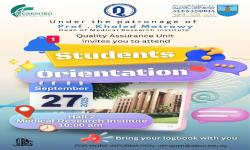
- Students Orientation Autumn 2025/26
- 6th October celebration
Students News

Students News Archive
- MRI Postgraduate application extension till 21 Aug...
- GraphPad Prism as a statistical tool for biomedica...
- Tools of References Management " EndNote "
- MRI Postgraduate application procedures
- Exam Schedule Spring 2025
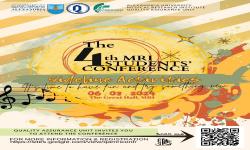
- The Fourth Student Conference of the Medical Resea...
- Announcement for new students, registration spring...
Conferences
Archive
- Diploma in Experimental and Clinical Parasitology.
- Master’s in Applied and Molecular Parasitology.
- PhD in Applied and Molecular Parasitology.
- Providing medical services for patients attending the Parasitology Department Clinic.
- Laboratory tests
- Stool examination for the diagnosis of parasitic diseases and determination of infection intensity. This includes direct smears, concentration techniques (saline sedimentation and formalin–ether), the Kato-Katz method for diagnosing intestinal schistosomiasis and fascioliasis, and permanently stained stool smears for identifying newly emerging protozoa (such as Cryptosporidium spp.).
- Detection of occult blood in stool for the diagnosis of various gastrointestinal diseases
- Blood film examination for the diagnosis of blood parasites as malaria and filariasis.
- Serological tests for the diagnosis of early infection and tissue parasites.
- ELISA test for Helicobacter pylori
- ELISA test for fecal calprotectin.
- Detection of Acanthamoeba in contact lenses.
- Collaboration with other Departments of MRI, Faculty of Medicine and HIPH in scientific research covering all aspects of parasitic diseases.
- The Parasitology Department has conducted numerous projects sponsored by the WHO and the Ministry of Health, focusing on the diagnosis, treatment and control of parasitic diseases endemic in Egypt mainly Schistosoma and
- Teaching courses for the Diploma, Master’s and PhD degrees offered by the Department, and Parasitology elective courses for students from other Departments.
- Conducting training courses for laboratory physicians and technicians on new diagnostic methods in Parasitology.
- Seminars and scientific meetings.
- Research on parasitic diseases prevalent in tropical regions, including their epidemiology, prevention, and control.
- Investigation of host immune responses to parasitic infections.
- Application of advanced diagnostic techniques for parasite detection, genotyping, and research.
- Development and assessment of the efficacy and safety of anti-parasitic drugs.
- Assessment of the current status of parasitic diseases, including newly emerging protozoa.
- Application of recent techniques in the diagnosis of parasitic infections.
- Searching for and testing new natural and synthetic therapies against parasitic diseases.
- Studying host-parasitic interactions at the molecular and cellular levels.