



Institute News

- Woman inner peace and family general health seminar announcement
- The 2nd Conference of Medical Biophysics and its Applications
- Handwashing awareness
- 6th october artistic and cultural competition announcement
- leukemia Awareness Month Sceitific day
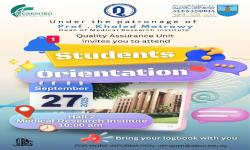
- Students Orientation Autumn 2025/26
- 6th October celebration
Students News

- MRI Postgraduate application extension till 21 Aug...
- GraphPad Prism as a statistical tool for biomedica...
- Tools of References Management " EndNote "
- MRI Postgraduate application procedures
- Exam Schedule Spring 2025
- The Fourth Student Conference of the Medical Resea...
- Announcement for new students, registration spring...
Conferences

About:
Leading education and research in biomedical engineering to improve human health
Biomedical engineering (BME) improves human health by combining physical, chemical, biological, and mathematical sciences with engineering principles to create solutions to a wide range of medical problems.
Biomedical engineers need a solid foundation in the biological sciences as well as a firm grasp of engineering principles and techniques to have access to interconnected engineering and medical resources.
At the medical research institute in September 2009, the biomedical engineering department was established to offer comprehensive education and research opportunities to students and industry interested in search of this topic.
At the department, biomedical engineering students are given the unique experience of being in a highly interdisciplinary department with diverse research opportunities and dynamic focus areas.
The department offers master programs within the framework of the medical research institute programs, establishing interests in biomedical instrumentation, biomedical signal and image processing and seeking to focus growth and excellence in these research areas as it grows.
The department actively coordinates and interfaces with other departments at the institute to facilitate automated and rapid detection and diagnosis of different diseases.
Biomedical engineering at our department has other goals: including, the use of the engineering simulation tools to better understand human physiology and disease.
BME graduates are a special brand of engineer.
Human Genetics Department – Medical Research Institute, Alexandria University
The Human Genetics Department was established in 1967 as one of the pioneering centers for the diagnosis and research of genetic disorders in Egypt and the Arab world. The department comprises three main units: the Genetics Clinic, which provides diagnostic services and genetic counseling for individuals and families; the Cytogenetics Laboratory, accredited by CAP for two consecutive cycles, offering chromosome analysis (Karyotyping) and Fluorescence In Situ Hybridization (FISH); and the Molecular Genetics Laboratory, which performs DNA-based testing to detect gene mutations.
The department plays a leading academic role by offering Master’s and PhD programs in Human Genetics, designed to prepare highly qualified specialists capable of conducting advanced genetic research and providing high-quality diagnostic services. These academic programs include hands-on training in cytogenetic and molecular laboratories, alongside supervision of scientific theses and the development of students’ research and analytical skills. Through these programs, the department contributes significantly to advancing medical and scientific capacity at both the national and regional levels.
About:
Our department is one of the academic departments at Medical Research Institute. It was established in early 1960s by our late Professor Dr. Gamal Eldin Abdel Tawab who was the pioneer of Tryptophan Research School in Egypt. The main objective of our department is to carry on scientific and biomedical research in different fields of medical biochemistry, molecular biology and environmental toxicology. Our highly experienced Emeritus Professors, well qualified staff of Professors, associates and colleagues together with motivated young chemists form a strong team work to carry on all scientific and biomedical research needed. Awarding Master and Ph.D. degrees to postgraduate students for candidates hold a Bachelor degree in Science, Pharmacy or Medicine and as well candidates from Arabian countries is one of our main objectives. Our cooperation with other departments in Medical Research Institute and from other colleges is also an important issue to expand our research fields and ideas. Our good laboratory facilities and staff experience enable us to support more candidates for master and Ph.D. degree. Meanwhile, our newly established Molecular Biology Laboratory encourage us to carry on new research protocols and as well research papers using these recent laboratory techniques.